
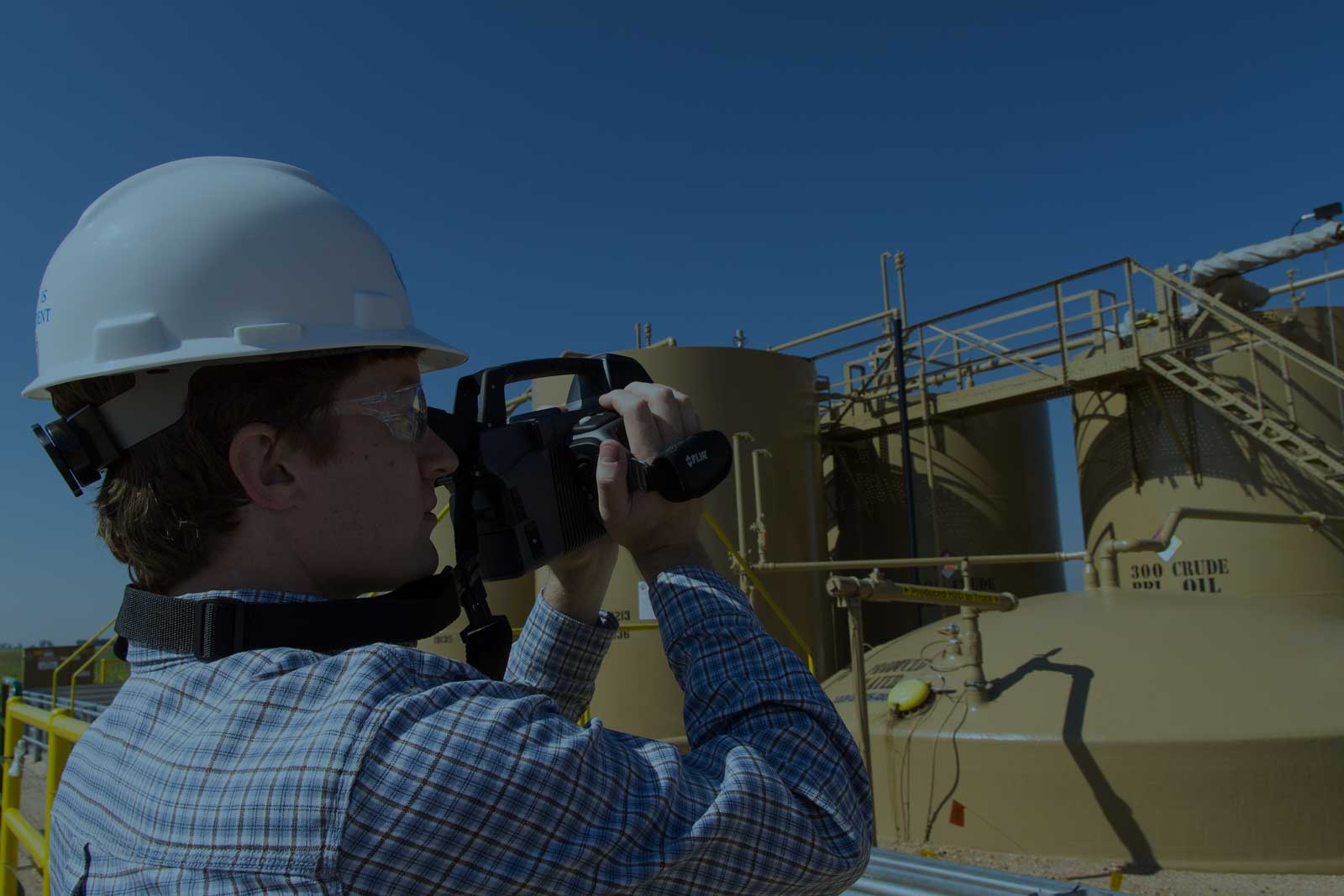
Advancing Emissions Detection and Monitoring Practices
While the oil and natural gas industry invests significant resources into maintaining their infrastructure, some leaks can be difficult to detect and may release methane and VOCs into the atmosphere.
There are a variety of ways companies are working to identify emission leaks, and the right option can vary across sectors with different types of assets. Detection technologies include laser absorption spectroscopy, optical gas imaging, and sensors. In addition to established ground-based monitoring approaches, many TEP members are incorporating aerial-based monitoring approaches with drones, airplanes, and space-based monitoring through satellites. Additionally, companies are identifying ways that operational information can be used to predict, prevent, and report emissions sources more accurately.
Reducing Emissions Through Action
Through TEP’s Leak Detection and Repair Program, we see that our participating companies are doing more – using more detection technologies, inspecting more sites and facilities, and conducting inspections more frequently – and when they find a leak, they are fixing them faster.
2025 Performance Highlights
- Over 680 million component inspections performed
- Over 800,000 surveys conducted
- Over 195,000 sites surveyed
- 0.02% leak occurrence rate, or less than 1 component leaking in a thousand
2018 – 2025 LEAK DETECTION AND REPAIR PROGRAM
- More than 2.6 billion component inspections performed
- More than 4 million surveys conducted
About The Program
| Program Specific | |
| Program Target |
Company plan will determine which sites/facilities will conduct LDAR monitoring and be included in the program. |
| Method |
Method 21, AVO, Optical Gas Imaging (OGI) camera, or other instrument/technologies |
|
Approach |
Meet regulatory requirements (federal, state and local) and implement one or more program enhancements beyond regulatory requirements at one or more sites/facilities included in the program. Program enhancements may include:
|
|
Repair Periods |
Complete repairs at a minimum per regulatory requirements or the equivalent for non-regulated sources and accelerate repair timing to the extent possible |