
Joint Message from Chairs and Director
The Environmental Partnership (TEP) participants continue to make significant progress and remain committed to reducing emissions. From the beginning, participants have committed to reducing emissions within their operations through innovative facility design, improvements in operational practices and procedures, advancements in detecting and measuring emissions, and improved accuracy in data emissions reporting.
The Partnership was formed in 2017 to provide a space for operators to learn from one another about methane reduction solutions and strategies and to leverage that collective knowledge to improve the industry’s environmental performance. Our membership represents a diverse range of companies and includes small and large operators within and across multiple oil and natural gas segments. This diversity of perspectives contributes significantly to the robust operator-to-operator sharing that is at the heart of The Partnership’s three principles of learning, collaborating and taking action.
Reducing methane emissions is a complex puzzle with many pieces, and each puzzle is unique to an individual operator’s makeup. There is not “a one size fits all” solution. Companies implement different methane mitigation approaches and strategies based on basin and regional characteristics, types of assets, company size, and the company’s individual emissions reduction goals. TEP helps participating companies navigate the wide range of solutions, make informed decisions on solutions that work best for their operations, and successfully assemble their unique methane reduction puzzle.
Industry’s success can be seen in the EPA’s Greenhouse Gas Reporting Program that shows that methane emissions from U.S. onshore oil & natural gas fell by 42% between 2015-2023. This reduction progress is owed to the ingenuity, creativity, and know-how of many of the individuals at our participating companies who have worked tirelessly to identify solutions and volunteer to share their expertise with others. Their ingenuity and commitment to tackling emissions are apparent in the Industry Spotlights highlighted throughout this report.
Each year, our annual report provides TEP with the opportunity to reflect on the achievements and advancements made since 2017 its start in and also to look towards the future and consider how we can better support our membership as they work to meet the dual challenge of increasing energy production while forging ahead on environmental progress.
Once again, participants made great strides across TEP’s environmental performance programs and took steps to advance best practices to reduce emissions. Through TEP’s Leak Detection and Repair Performance Program reporting, we see that TEP companies are doing more – using more detection technologies, inspecting more sites and facilities, and conducting inspections more frequently – and when they find a leak, they are fixing them faster. Companies inspected over 199,000 sites, two-thirds of which were monitored voluntarily beyond regulatory requirements. And similarly, TEP’s 2024 flare study highlighted operator attentiveness in flare maintenance and performance to reduce emissions, showing that for the flares tested, 88.95% were above 98% destruction and removal efficiency (DRE) and 99.45% were above 95% DRE.
We are proud of the significant work our members have accomplished towards supporting emissions reduction progress and advancing environmental solutions. Although solutions may vary company to company, the one constant is that TEP participating companies are all committed to working together to responsibly develop our nation’s essential oil and natural gas resources while continuing to enhance environmental performance.
2024
Participating Companies







2024 Performance Highlights
Leak Detection And Repair Program
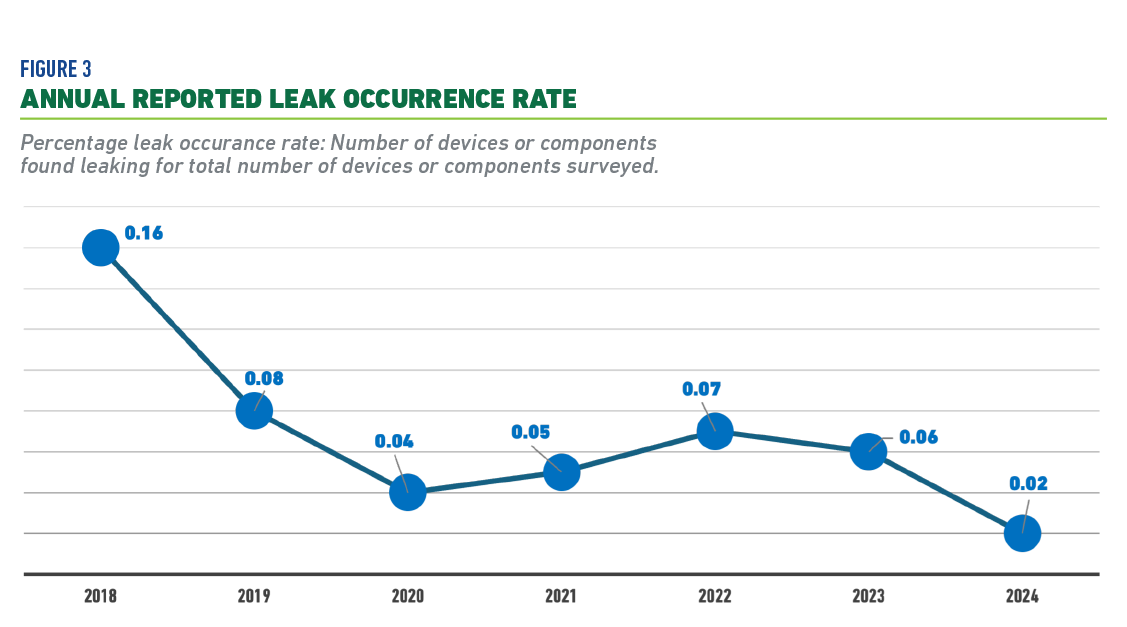
Leak monitoring using detection methods and technologies including portable analyzers, optical gas imaging cameras, and aerial surveys, followed by timely repair. Expanding technology means that leaks can be identified sooner, which enables timely repairs.
- More than 658 million component inspections performed
- Over 678,000 surveys conducted
- Over 199,000 sites surveyed
- 0.02% leak occurrence rate, or less than 1 component leaking in a thousand
Pipeline Blowdown Program
Implement reduction practices to minimize emissions during pipeline blowdowns – including routing natural gas to a low-pressure system or reducing pressure.
- Emissions Reduction Practices implemented during more than 10,400 pipeline blowdowns
Compressor Program
Implement reduction practices that minimize emissions associated with centrifugal and reciprocating compressors – including routing vapors to control or replacing rod packings.
- Rod packing changes on more than 3,600 reciprocating compressors
- Approved emissions reduction practices utilized on more than 1,100 compressors
- Over 275 compressor engines replaced with or installed with electric motors
Maintenance And Integrity Program
Best practices that improve liquid petroleum pipeline and facility integrity and maintenance programs to reduce emissions and product releases to the environment.
- More than 24,300 preventative maintenance activities completed for over 37,700 miles of liquid pipelines
- Over 3,500 preventative maintenance activities completed for liquid pipeline-associated facilities
- Over 17,350 miles of liquid pipeline inspected with inline inspection tools
Energy Efficiencies In Operations Program
Implement best practices to reduce energy consumption for liquid petroleum pipelines and facilities within the transmission and storage segments.
- More than 1,175 liquid pipeline-associated facilities applied or considered energy reduction methods
Flare Management Program
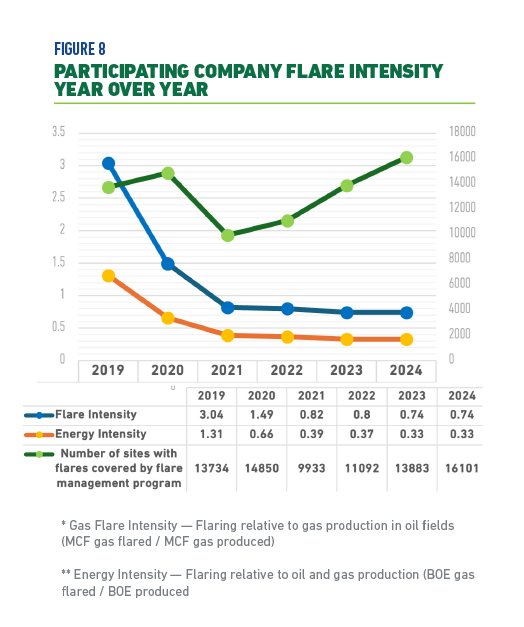
Implement practices to reduce flare volumes, promote beneficial use of associated gas and calculate flare intensity to demonstrate progress.
Empowering
Action through Collective Work and Knowledge
The Partnership was established with the aim of facilitating sharing of operational learnings and solutions that reduce methane emissions. TEP helps to expand individual company progress through collective research efforts targeting current emissions challenges and opportunities. Below are some of the key projects TEP organized last year to leverage members’ ingenuity, creativity, and experience, to deliver actionable data and learnings.
The information provided from the projects enables companies to make more informed decisions that are fit for their unique operations and emission reduction goals.
Advancing
Emissions Detection and Monitoring Practices
Since TEP’s start, participants have worked hard to implement robust leak detection and repair (LDAR) programs within their organizations to find and fix unintentional emissions from equipment as soon as possible.
Last year, TEP redesigned its LDAR Environmental Performance Program to better align with current industry practices and fully capture the advancements companies have made in the past eight years to detect, monitor, and prevent leaks from occurring within their operations.
Promoting
Flare Efficiency Practices
TEP companies have made significant progress in reducing overall flare volumes since TEP’s flare management program was launched in 2020.
Last year, The Partnership conducted a study to better understand and promote flare efficiency and reliability best practices for times when flaring is necessary. Flaring typically occurs when there is a lack of takeaway or processing capacity, during facility or downstream facility maintenance, or during unplanned events that may require flaring to safely alleviate pressure. In these instances, flaring is better for the environment than venting the gas directly into the air because it releases fewer greenhouse gases.
Leveraging
Operational Parameters to Predict and Prevent Emissions
Many TEP operators are exploring how to use existing SCADA systems that collect, monitor, and control field operations remotely to predict, prevent, and report on emission events. In 2024, The Partnership organized an effort to develop a performance practice on the use of operational parameters data and other operational information to predict, prevent, and report emissions sources more accurately.
Expanding
Compressor Knowledge through Collective Data Analysis
TEP companies continue to work together towards step change-type actions and solutions to reduce emissions from compressors – particularly, compressor engine slip emissions. Last year, TEP conducted a compressor engine survey to analyze engine stack testing data provided by TEP operators.
Driving
Progress Through Learning And Collaboration
Sharing best practices and solutions among peers and with other stakeholders who share the goals of reducing emissions and improving environmental performance is the cornerstone of The Partnership.
Through our learning and collaboration principles, we drive positive change and industry improvement by providing members an opportunity to convene, learn, and share valuable information about new strategies and emerging technologies to reduce emissions. Many of the unique challenges that individual operators face are, in fact, solvable when tackled together through open dialogue with industry peers and other experts.
Regional Workshops
In 2024, TEP held three in-person workshops in the Appalachian, Bakken, and Permian Basin regions. These events brought together air quality company experts to promote sharing of operational learnings and solutions to reduce methane emissions and further our industry’s progress toward improving environmental performance.
The Appalachian Basin workshop focused on topics relevant to their basin-specific operations including produced water tank emissions and controls, pneumatic controller emissions solutions, compressor emissions characterization and liquid unloading practices. The Bakken Workshop covered flare management, TEP research projects underway, emissions monitoring, drilling and completion strategies, pneumatic controllers, and more. The workshop also included a presentation on the iPIPE and flare projects underway at the University of North Dakota Energy & Environmental Research Center.
The Permian Basin Workshop brought together local operators representing 28 companies to discuss shared challenges and learn about ways to detect and drive down methane emissions. Company air and engineering experts discussed methane regulatory compliance challenges, compressor emissions solutions, and shared practices on how companies are using operational parameter data (SCADA, PI Tags, parametric data, pressure, temperatures, etc.) to predict, prevent, and report emissions more accurately. Staff from TCEQ’s Air Permitting Division also provided a presentation covering the new federal methane regulations and next steps for how Texas will implement these standards into its State Implementation Plan.
Metec Ogi Camera Training
In June 2024, TEP company representatives attended a two-day course at the Methane Emission Technology Evaluation Center (METEC) at Colorado State University, a long-standing partner of TEP.
The optical gas imaging (OGI) camera training provided attendees with the opportunity to improve their methodology and performance through hands-on application, simulated leak detection and repair (LDAR) scenarios and direct feedback from METEC experts.
These events support TEP’s key principle of collaboration – providing an opportunity for operators to share ideas, learning from subject matter experts, and expand their abilities in operational practices and technologies.
Annual Meeting, Conference And Technology Forum
Wrapping up another productive year, more than 170 operators and industry stakeholders and partners attended The Environmental Partnership’s 7th Annual Meeting and Conference in Houston in December.
TEP participants discussed ways to evolve TEP programs to ensure that its performance actions continue to align with the key industry advancements as well as the evolution in methane-related regulations.
Attendees also shared strategies on how they are incorporating different monitoring technologies into their leak detection and repair programs to identify and prevent emissions and shared insights on the evolution of methane measurement studies to further understanding of methane emission sources and advance reconciliation between top-down and bottom-up methane emission estimates.
Held alongside the annual meeting, the technology forum featured exhibits from 20 industry partners, providing a chance for attendees to engage with a range of companies that are working with industry to implement innovative technologies to reduce emissions.
2025
Acknowledgements
We would like to thank the dedicated individuals who contribute to The Environmental Partnership’s core mission of sharing learnings, including external partners who presented during workshops and collaborated on research and studies in 2024. We look forward to the future as we continue to welcome new companies and industry collaboration.